
Advertisement
-
Published Date
March 23, 2026This ad was originally published on this date and may contain an offer that is no longer valid. To learn more about this business and its most recent offers, click here.
Ad Text
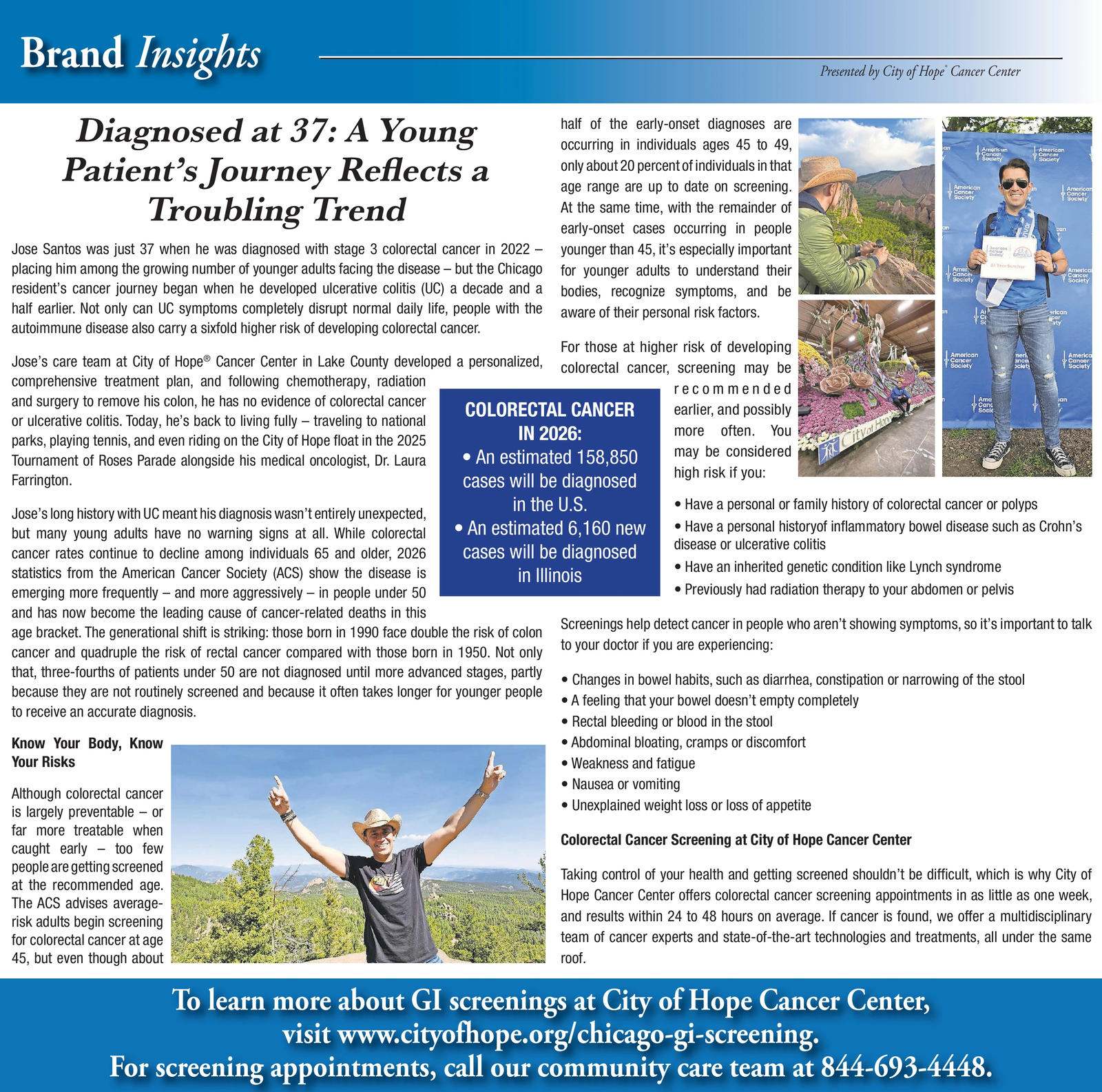
Brand Insights Diagnosed at 37: A Young Patient's Journey Reflects a Troubling Trend Jose Santos was just 37 when he was diagnosed with stage 3 colorectal cancer in 2022 - placing him among the growing number of younger adults facing the disease - but the Chicago resident's cancer journey began when he developed ulcerative colitis (UC) a decade and a half earlier. Not only can UC symptoms completely disrupt normal daily life, people with the autoimmune disease also carry a sixfold higher risk of developing colorectal cancer. half of the early-onset diagnoses are occurring in individuals ages 45 to 49, only about 20 percent of individuals in that age range are up to date on screening. At the same time, with the remainder of early-onset cases occurring in people younger than 45, it's especially important for younger adults to understand their bodies, recognize symptoms, and be aware of their personal risk factors. For those at higher risk of developing colorectal cancer, screening may be COLORECTAL CANCER Jose's care team at City of Hope® Cancer Center in Lake County developed a personalized, comprehensive treatment plan, and following chemotherapy, radiation and surgery to remove his colon, he has no evidence of colorectal cancer or ulcerative colitis. Today, he's back to living fully - traveling to national parks, playing tennis, and even riding on the City of Hope float in the 2025 Tournament of Roses Parade alongside his medical oncologist, Dr. Laura Farrington. IN 2026: An estimated 158,850 cases will be diagnosed in the U.S. An estimated 6,160 new cases will be diagnosed in Illinois Jose's long history with UC meant his diagnosis wasn't entirely unexpected, but many young adults have no warning signs at all. While colorectal cancer rates continue to decline among individuals 65 and older, 2026 statistics from the American Cancer Society (ACS) show the disease is emerging more frequently - and more aggressively - in people under 50 and has now become the leading cause of cancer-related deaths in this age bracket. The generational shift is striking: those born in 1990 face double the risk of colon cancer and quadruple the risk of rectal cancer compared with those born in 1950. Not only that, three-fourths of patients under 50 are not diagnosed until more advanced stages, partly because they are not routinely screened and because it often takes longer for younger people to receive an accurate diagnosis. Know Your Body, Know Your Risks Although colorectal cancer is largely preventable - or far more treatable when caught early - too few people are getting screened at the recommended age. The ACS advises average- risk adults begin screening for colorectal cancer at age 45, but even though about recommended earlier, and possibly more often. You may be considered high risk if you: Presented by City of Hope Cancer Center American Society Society' American American Society erican ty American Society Concer America Concor Society American nerk ociety America Cancer Society Cancer Society Canc Socie Have a personal or family history of colorectal cancer or polyps Have a personal historyof inflammatory bowel disease such as Crohn's disease or ulcerative colitis Have an inherited genetic condition like Lynch syndrome Previously had radiation therapy to your abdomen or pelvis Screenings help detect cancer in people who aren't showing symptoms, so it's important to talk to your doctor if you are experiencing: Changes in bowel habits, such as diarrhea, constipation or narrowing of the stool A feeling that your bowel doesn't empty completely Rectal bleeding or blood in the stool Abdominal bloating, cramps or discomfort Weakness and fatigue Nausea or vomiting . Unexplained weight loss or loss of appetite Colorectal Cancer Screening at City of Hope Cancer Center Taking control of your health and getting screened shouldn't be difficult, which is why City of Hope Cancer Center offers colorectal cancer screening appointments in as little as one week, and results within 24 to 48 hours on average. If cancer is found, we offer a multidisciplinary team of cancer experts and state-of-the-art technologies and treatments, all under the same roof. To learn more about GI screenings at City of Hope Cancer Center, visit www.cityofhope.org/chicago-gi-screening. For screening appointments, call our community care team at 844-693-4448. Brand Insights Diagnosed at 37 : A Young Patient's Journey Reflects a Troubling Trend Jose Santos was just 37 when he was diagnosed with stage 3 colorectal cancer in 2022 - placing him among the growing number of younger adults facing the disease - but the Chicago resident's cancer journey began when he developed ulcerative colitis ( UC ) a decade and a half earlier . Not only can UC symptoms completely disrupt normal daily life , people with the autoimmune disease also carry a sixfold higher risk of developing colorectal cancer . half of the early - onset diagnoses are occurring in individuals ages 45 to 49 , only about 20 percent of individuals in that age range are up to date on screening . At the same time , with the remainder of early - onset cases occurring in people younger than 45 , it's especially important for younger adults to understand their bodies , recognize symptoms , and be aware of their personal risk factors . For those at higher risk of developing colorectal cancer , screening may be COLORECTAL CANCER Jose's care team at City of Hope® Cancer Center in Lake County developed a personalized , comprehensive treatment plan , and following chemotherapy , radiation and surgery to remove his colon , he has no evidence of colorectal cancer or ulcerative colitis . Today , he's back to living fully - traveling to national parks , playing tennis , and even riding on the City of Hope float in the 2025 Tournament of Roses Parade alongside his medical oncologist , Dr. Laura Farrington . IN 2026 : An estimated 158,850 cases will be diagnosed in the U.S. An estimated 6,160 new cases will be diagnosed in Illinois Jose's long history with UC meant his diagnosis wasn't entirely unexpected , but many young adults have no warning signs at all . While colorectal cancer rates continue to decline among individuals 65 and older , 2026 statistics from the American Cancer Society ( ACS ) show the disease is emerging more frequently - and more aggressively - in people under 50 and has now become the leading cause of cancer - related deaths in this age bracket . The generational shift is striking : those born in 1990 face double the risk of colon cancer and quadruple the risk of rectal cancer compared with those born in 1950. Not only that , three - fourths of patients under 50 are not diagnosed until more advanced stages , partly because they are not routinely screened and because it often takes longer for younger people to receive an accurate diagnosis . Know Your Body , Know Your Risks Although colorectal cancer is largely preventable - or far more treatable when caught early - too few people are getting screened at the recommended age . The ACS advises average- risk adults begin screening for colorectal cancer at age 45 , but even though about recommended earlier , and possibly more often . You may be considered high risk if you : Presented by City of Hope Cancer Center American Society Society ' American American Society erican ty American Society Concer America Concor Society American nerk ociety America Cancer Society Cancer Society Canc Socie Have a personal or family history of colorectal cancer or polyps Have a personal historyof inflammatory bowel disease such as Crohn's disease or ulcerative colitis Have an inherited genetic condition like Lynch syndrome Previously had radiation therapy to your abdomen or pelvis Screenings help detect cancer in people who aren't showing symptoms , so it's important to talk to your doctor if you are experiencing : Changes in bowel habits , such as diarrhea , constipation or narrowing of the stool A feeling that your bowel doesn't empty completely Rectal bleeding or blood in the stool Abdominal bloating , cramps or discomfort Weakness and fatigue Nausea or vomiting . Unexplained weight loss or loss of appetite Colorectal Cancer Screening at City of Hope Cancer Center Taking control of your health and getting screened shouldn't be difficult , which is why City of Hope Cancer Center offers colorectal cancer screening appointments in as little as one week , and results within 24 to 48 hours on average . If cancer is found , we offer a multidisciplinary team of cancer experts and state - of - the - art technologies and treatments , all under the same roof . To learn more about GI screenings at City of Hope Cancer Center , visit www.cityofhope.org/chicago-gi-screening . For screening appointments , call our community care team at 844-693-4448 .