
Advertisement
-
Published Date
April 8, 2026This ad was originally published on this date and may contain an offer that is no longer valid. To learn more about this business and its most recent offers, click here.
Ad Text
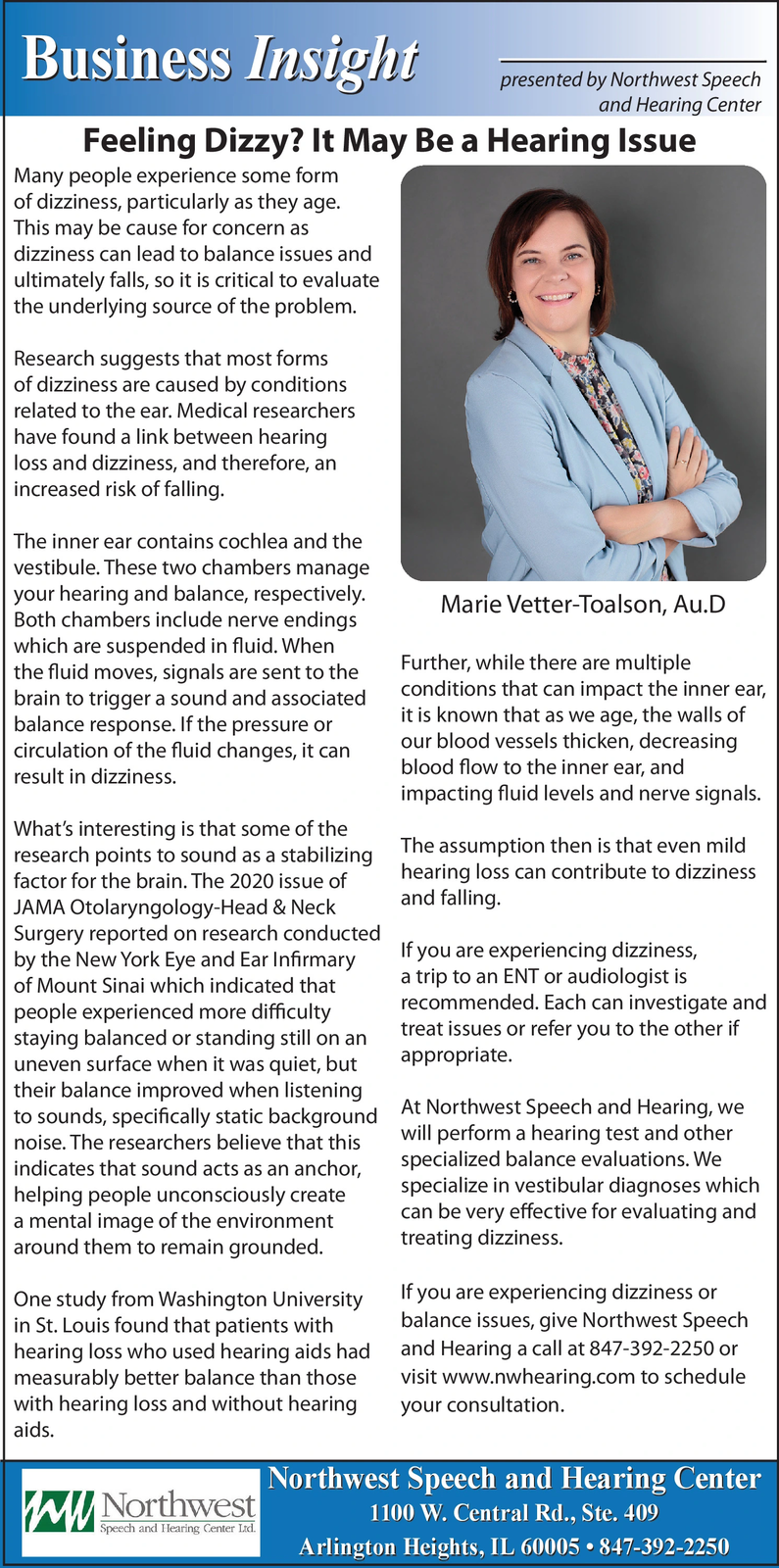
Business Insight presented by Northwest Speech and Hearing Center Feeling Dizzy? It May Be a Hearing Issue Many people experience some form of dizziness, particularly as they age. This may be cause for concern as dizziness can lead to balance issues and ultimately falls, so it is critical to evaluate the underlying source of the problem. Research suggests that most forms of dizziness are caused by conditions related to the ear. Medical researchers have found a link between hearing loss and dizziness, and therefore, an increased risk of falling. The inner ear contains cochlea and the vestibule. These two chambers manage your hearing and balance, respectively. Both chambers include nerve endings which are suspended in fluid. When the fluid moves, signals are sent to the brain to trigger a sound and associated balance response. If the pressure or circulation of the fluid changes, it can result in dizziness. What's interesting is that some of the Marie Vetter-Toalson, Au.D Further, while there are multiple conditions that can impact the inner ear, it is known that as we age, the walls of our blood vessels thicken, decreasing blood flow to the inner ear, and impacting fluid levels and nerve signals. research points to sound as a stabilizing The assumption then is that even mild factor for the brain. The 2020 issue of JAMA Otolaryngology-Head & Neck Surgery reported on research conducted by the New York Eye and Ear Infirmary of Mount Sinai which indicated that people experienced more difficulty staying balanced or standing still on an uneven surface when it was quiet, but their balance improved when listening to sounds, specifically static background noise. The researchers believe that this indicates that sound acts as an anchor, helping people unconsciously create a mental image of the environment around them to remain grounded. One study from Washington University in St. Louis found that patients with hearing loss who used hearing aids had measurably better balance than those with hearing loss and without hearing aids. ww Northwest Speech and Hearing Center Ltd. | hearing loss can contribute to dizziness and falling. If you are experiencing dizziness, a trip to an ENT or audiologist is recommended. Each can investigate and treat issues or refer you to the other if appropriate. At Northwest Speech and Hearing, we will perform a hearing test and other specialized balance evaluations. We specialize in vestibular diagnoses which can be very effective for evaluating and treating dizziness. If you are experiencing dizziness or balance issues, give Northwest Speech and Hearing a call at 847-392-2250 or visit www.nwhearing.com to schedule your consultation. Northwest Speech and Hearing Center 1100 W. Central Rd., Ste. 409 Arlington Heights, IL 60005 847-392-2250 Business Insight presented by Northwest Speech and Hearing Center Feeling Dizzy ? It May Be a Hearing Issue Many people experience some form of dizziness , particularly as they age . This may be cause for concern as dizziness can lead to balance issues and ultimately falls , so it is critical to evaluate the underlying source of the problem . Research suggests that most forms of dizziness are caused by conditions related to the ear . Medical researchers have found a link between hearing loss and dizziness , and therefore , an increased risk of falling . The inner ear contains cochlea and the vestibule . These two chambers manage your hearing and balance , respectively . Both chambers include nerve endings which are suspended in fluid . When the fluid moves , signals are sent to the brain to trigger a sound and associated balance response . If the pressure or circulation of the fluid changes , it can result in dizziness . What's interesting is that some of the Marie Vetter - Toalson , Au.D Further , while there are multiple conditions that can impact the inner ear , it is known that as we age , the walls of our blood vessels thicken , decreasing blood flow to the inner ear , and impacting fluid levels and nerve signals . research points to sound as a stabilizing The assumption then is that even mild factor for the brain . The 2020 issue of JAMA Otolaryngology - Head & Neck Surgery reported on research conducted by the New York Eye and Ear Infirmary of Mount Sinai which indicated that people experienced more difficulty staying balanced or standing still on an uneven surface when it was quiet , but their balance improved when listening to sounds , specifically static background noise . The researchers believe that this indicates that sound acts as an anchor , helping people unconsciously create a mental image of the environment around them to remain grounded . One study from Washington University in St. Louis found that patients with hearing loss who used hearing aids had measurably better balance than those with hearing loss and without hearing aids . ww Northwest Speech and Hearing Center Ltd. | hearing loss can contribute to dizziness and falling . If you are experiencing dizziness , a trip to an ENT or audiologist is recommended . Each can investigate and treat issues or refer you to the other if appropriate . At Northwest Speech and Hearing , we will perform a hearing test and other specialized balance evaluations . We specialize in vestibular diagnoses which can be very effective for evaluating and treating dizziness . If you are experiencing dizziness or balance issues , give Northwest Speech and Hearing a call at 847-392-2250 or visit www.nwhearing.com to schedule your consultation . Northwest Speech and Hearing Center 1100 W. Central Rd . , Ste . 409 Arlington Heights , IL 60005 847-392-2250