
Advertisement
-
Published Date
April 26, 2026This ad was originally published on this date and may contain an offer that is no longer valid. To learn more about this business and its most recent offers, click here.
Ad Text
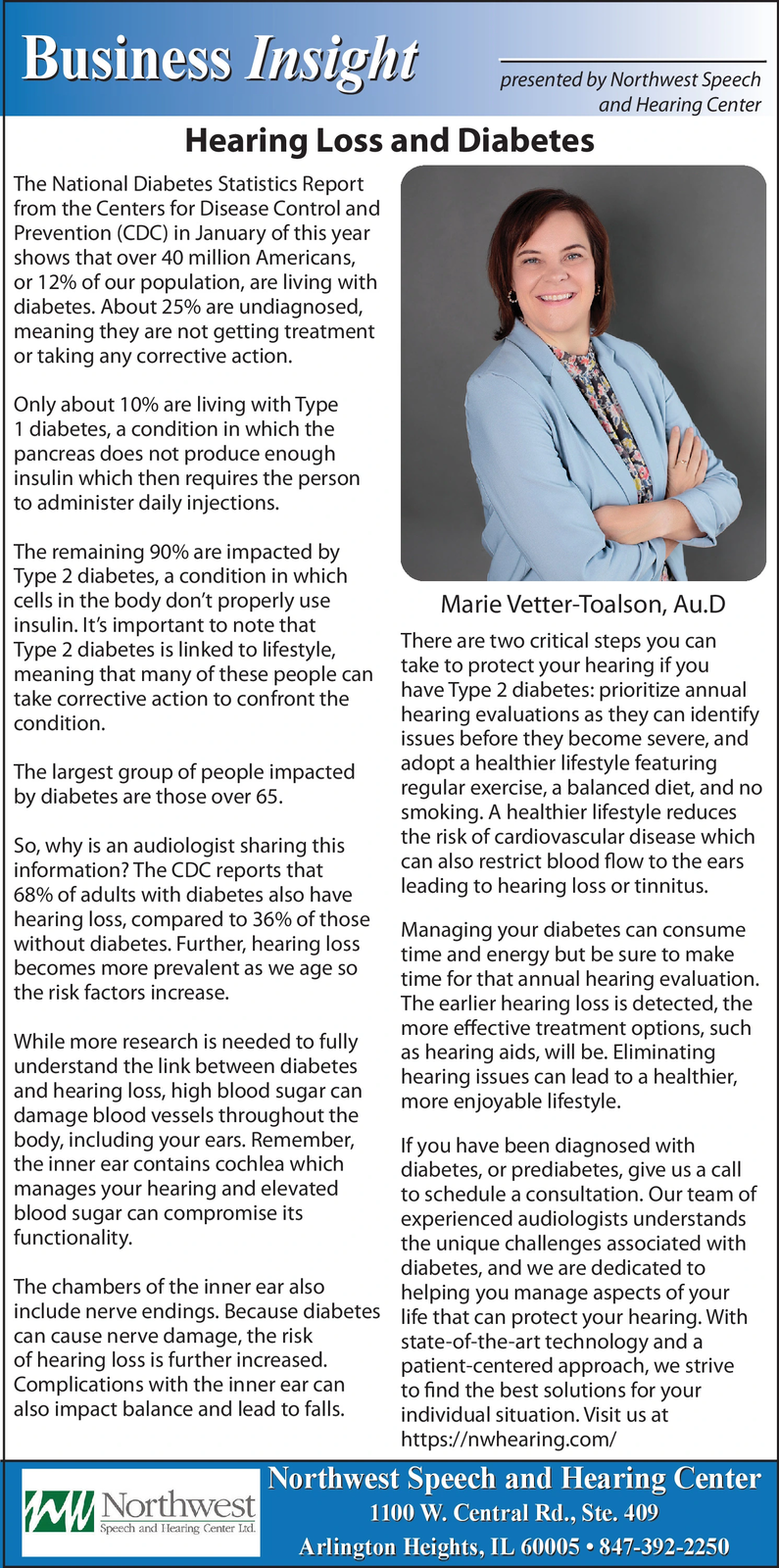
Business Insight presented by Northwest Speech and Hearing Center Hearing Loss and Diabetes The National Diabetes Statistics Report from the Centers for Disease Control and Prevention (CDC) in January of this year shows that over 40 million Americans, or 12% of our population, are living with diabetes. About 25% are undiagnosed, meaning they are not getting treatment or taking any corrective action. Only about 10% are living with Type 1 diabetes, a condition in which the pancreas does not produce enough insulin which then requires the person to administer daily injections. The remaining 90% are impacted by Type 2 diabetes, a condition in which cells in the body don't properly use insulin. It's important to note that Type 2 diabetes is linked to lifestyle, meaning that many of these people can take corrective action to confront the condition. The largest group of people impacted by diabetes are those over 65. So, why is an audiologist sharing this information? The CDC reports that 68% of adults with diabetes also have hearing loss, compared to 36% of those without diabetes. Further, hearing loss becomes more prevalent as we age so the risk factors increase. While more research is needed to fully understand the link between diabetes and hearing loss, high blood sugar can damage blood vessels throughout the body, including your ears. Remember, the inner ear contains cochlea which manages your hearing and elevated blood sugar can compromise its functionality. The chambers of the inner ear also include nerve endings. Because diabetes can cause nerve damage, the risk of hearing loss is further increased. Complications with the inner ear can also impact balance and lead to falls. ww Northwest Speech and Hearing Center Ltd. Marie Vetter-Toalson, Au.D There are two critical steps you can take to protect your hearing if you have Type 2 diabetes: prioritize annual hearing evaluations as they can identify issues before they become severe, and adopt a healthier lifestyle featuring regular exercise, a balanced diet, and no smoking. A healthier lifestyle reduces the risk of cardiovascular disease which can also restrict blood flow to the ears leading to hearing loss or tinnitus. Managing your diabetes can consume time and energy but be sure to make time for that annual hearing evaluation. The earlier hearing loss is detected, the more effective treatment options, such as hearing aids, will be. Eliminating hearing issues can lead to a healthier, more enjoyable lifestyle. If you have been diagnosed with diabetes, or prediabetes, give us a call to schedule a consultation. Our team of experienced audiologists understands the unique challenges associated with diabetes, and we are dedicated to helping you manage aspects of your life that can protect your hearing. With state-of-the-art technology and a patient-centered approach, we strive to find the best solutions for your individual situation. Visit us at https://nwhearing.com/ | Northwest Speech and Hearing Center 1100 W. Central Rd., Ste. 409 Arlington Heights, IL 60005 847-392-2250 Business Insight presented by Northwest Speech and Hearing Center Hearing Loss and Diabetes The National Diabetes Statistics Report from the Centers for Disease Control and Prevention ( CDC ) in January of this year shows that over 40 million Americans , or 12 % of our population , are living with diabetes . About 25 % are undiagnosed , meaning they are not getting treatment or taking any corrective action . Only about 10 % are living with Type 1 diabetes , a condition in which the pancreas does not produce enough insulin which then requires the person to administer daily injections . The remaining 90 % are impacted by Type 2 diabetes , a condition in which cells in the body don't properly use insulin . It's important to note that Type 2 diabetes is linked to lifestyle , meaning that many of these people can take corrective action to confront the condition . The largest group of people impacted by diabetes are those over 65 . So , why is an audiologist sharing this information ? The CDC reports that 68 % of adults with diabetes also have hearing loss , compared to 36 % of those without diabetes . Further , hearing loss becomes more prevalent as we age so the risk factors increase . While more research is needed to fully understand the link between diabetes and hearing loss , high blood sugar can damage blood vessels throughout the body , including your ears . Remember , the inner ear contains cochlea which manages your hearing and elevated blood sugar can compromise its functionality . The chambers of the inner ear also include nerve endings . Because diabetes can cause nerve damage , the risk of hearing loss is further increased . Complications with the inner ear can also impact balance and lead to falls . ww Northwest Speech and Hearing Center Ltd. Marie Vetter - Toalson , Au.D There are two critical steps you can take to protect your hearing if you have Type 2 diabetes : prioritize annual hearing evaluations as they can identify issues before they become severe , and adopt a healthier lifestyle featuring regular exercise , a balanced diet , and no smoking . A healthier lifestyle reduces the risk of cardiovascular disease which can also restrict blood flow to the ears leading to hearing loss or tinnitus . Managing your diabetes can consume time and energy but be sure to make time for that annual hearing evaluation . The earlier hearing loss is detected , the more effective treatment options , such as hearing aids , will be . Eliminating hearing issues can lead to a healthier , more enjoyable lifestyle . If you have been diagnosed with diabetes , or prediabetes , give us a call to schedule a consultation . Our team of experienced audiologists understands the unique challenges associated with diabetes , and we are dedicated to helping you manage aspects of your life that can protect your hearing . With state - of - the - art technology and a patient - centered approach , we strive to find the best solutions for your individual situation . Visit us at https://nwhearing.com/ | Northwest Speech and Hearing Center 1100 W. Central Rd . , Ste . 409 Arlington Heights , IL 60005 847-392-2250